A small property needs the same daily operations whether it belongs to an independent owner or a national fund, and its rent roll cannot support a site team. Rentonomy is the AI property manager that runs those assets under one owner policy, executes locally without property-level staff, and verifies every result.
Funds, multi-property owners, and acquisition teams holding 1-to-100-unit rental assets that lack a dedicated onsite operating team, across one market or many.
What matters hereNOIAcquisitionsPortfolio varianceUnstaffed assetsGoverned AI
Why smaller assets resist scale
Funds cannot standardize fragmented local operations.
Fragmented local operations make smaller assets harder to acquire, integrate, and scale across a portfolio. For the buyer who solves the operating model, that complexity becomes an advantage. Hover any of these to see what changes.
01Acquisitions
Every deal inherits a different operating model.
Each acquisition arrives with its own manager, vendors, habits, and records, and integration becomes a project for every asset.
With Rentonomy
Rentonomy onboards the asset into one system of record and one owner policy. The operating model travels with the portfolio instead of being rebuilt around every property.
02Staffing
The rent roll cannot support a site team.
Below the onsite-staff threshold, the choice is a thinly staffed third-party manager or asset managers doing operations by email.
With Rentonomy
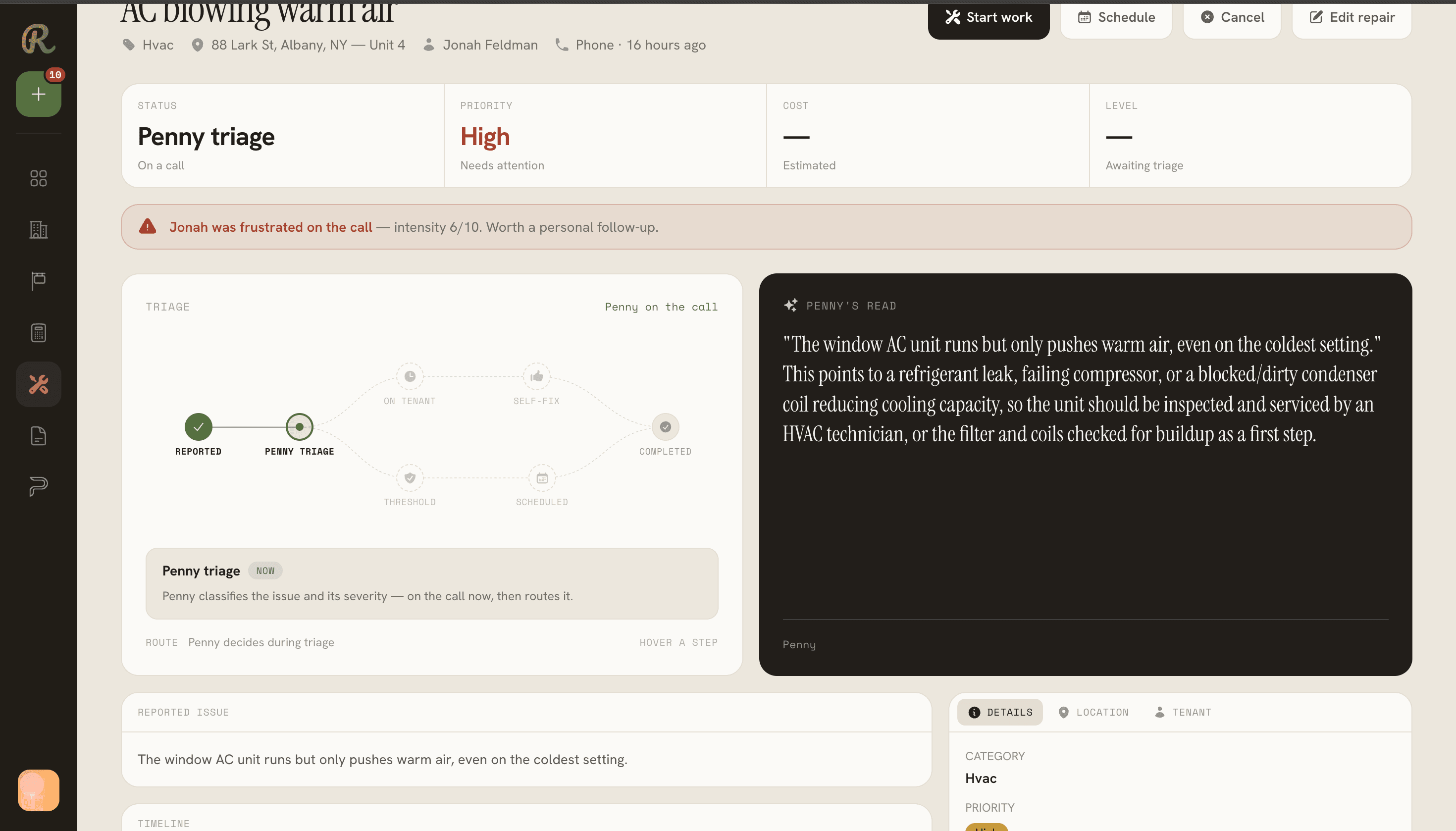
Penny carries routine work from policy to verified completion across software and local professionals. Property operations stop scaling with property-level headcount.
03Maintenance
Local labor differs in every market.
Vendor benches, pricing, and quality vary by metro, and nobody can compare them across the portfolio.
With Rentonomy
Rentonomy maps professionals by trade, distance, availability, climate demand, and price, verifies insurance and licenses, and routes by skill level. Every repair follows the lowest-cost safe path, with owner-approved pricing.
04Governance
High-stakes work needs a visible decision path.
When automation touches housing decisions, “the system did it” is not an answer you can give an LP, a regulator, or a court.
With Rentonomy
Approvals, spend thresholds, policy versions, and audit history are part of the workflow, not a report run afterward. Fair housing safeguards apply to every housing decision, and every consequential action names the person who approved it.
Start with unstaffed assets, then expand
Portfolio policy. Property-level execution.
Win the owner’s unstaffed assets in one market, then expand to other properties and markets. Penny operates from one connected record while honoring the differences that matter by property, resident, contract, and market — and housing decisions stay with your people inside fair housing rules.
01Connect
Bring the assets into one record.
Properties, units, leases, balances, providers, communications, documents, and open work, across every market.
02Govern
Encode the owner policy.
Approvals, spend thresholds, timing, risk posture, property rules, exceptions, and the decisions that always require people.
03Execute & verify
Close the loop locally.
Penny carries each workflow across software and local professionals until the result is verified, with one history of what happened and why.
Penny at workEvery next step visible
One operating model, clearly governed
Standardize what should repeat. Escalate what should not.
Property management software sells infrastructure and leaves local execution with the operator. Traditional managers supply labor that scales with people. Rentonomy makes the operating model executable: routine work follows the approved path to a verified outcome, and exceptions reach the right person with context.
The portfolio gains
One owner policy and approval model across every asset
Routine operations without property-level staff
Verified local execution in every market
One traceable record of action, provider, cost, and outcome
Comparable service and cost signals across properties
Your team retains
Pricing, acquisitions, and investment strategy
Applicant decisions and resident judgment
Material spending, legal action, and regulated decisions
A clear path to surface exceptions and improve policy
The portfolio case
Protect NOI with operating clarity.
Management cost is part of NOI you can actually move, and value is NOI divided by cap rate. Against the average management fee at $1,500 rent, Rentonomy saves roughly $93,000 a year in base fees on a single 100-unit building — about $1.86 million of value at a 5% cap, with no rent increase and no capital spend.
01 / Underwriting
Bid with savings you can prove.
About $930 per unit per year in base-fee savings supports roughly $18,500 more per unit in price at a 5% cap and the same yield.
02 / Execution
One standard that reaches the work.
Owner policy becomes the daily operating path on every asset, rather than a document that depends on each local manager.
03 / Risk
Governance stays in the loop.
Human approvals, fair housing safeguards, permissions, and reviewable history stay attached to every consequential action.
A focused path to proof
Bring the assets nobody can staff.
Start with the unstaffed properties in one market or portfolio slice. Prove the service, cost, and control case, then expand across the portfolio with evidence.